
Results
Phase One: Establishing Baseline Levels (2017-2018)
The Health Effects Monitoring Program (YKHEMP) began in 2017 with the main objective to establish a baseline of contaminant exposure and possible health effects in Yellowknife, Ndilo and Dettah, NWT, to ensure the Giant Mine Remediation Project does not negatively impact the health of the communities during remediation activities at the mine site. The study also aimed to answer the question of whether local residents were being exposed to higher levels of arsenic compared to other Canadians.
YKHEMP is a long-term monitoring program and as such, will be repeated every five years to follow the trends and investigate the long-term relationships between arsenic in the urine and toenails, and health effects. Baseline levels, for arsenic and other contaminants of potential concern including antimony, cadmium, lead, manganese and vanadium, were completed in 2018. Establishing this baseline was very important in making sure accurate monitoring of exposure to arsenic is done in the years to come.
YKHEMP uses Reference Levels to compare Yellowknife area populations to other Canadians.
What are Reference Levels?
Every few years, Statistics Canada measures arsenic levels with thousands of urine samples from around the country for the Canadian Health Measures Survey. Using that information they found that 95% of Canadians have 27 µg/L or less Total Arsenic (a combination of organic and inorganic arsenic species) in their urine. And, they found that 95% of Canadians have 21 µg/L or less Inorganic Arsenic (toxic) in their urine.
How much is that?
21 or 27 drops of water in a 10,000-gallon swimming pool.
Preliminary summary results were shared with the public during community meetings with the Yellowknife population, the Yellowknives Dene First Nation and the North Slave Métis Alliance between May and June 2019.
Key Findings from Baseline Sample Collection:
Most people tested had urinary total arsenic levels comparable to the average Canadian. For more summary results, check out our results brochure, for more detailed results check out our 2020 Report or publications.
NEXT STEPS:
Fall 2026
Organize community gatherings to share all available results.
2028
10-year follow-up resampling for all participants, including adults.
2032
Follow up testing for past participants & Testing for new participants
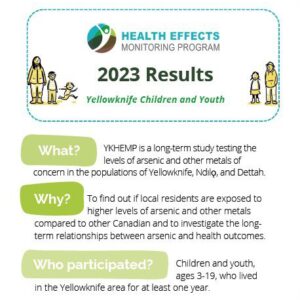
2023 Follow-up Study Results Booklet

Results Booklet (2017-18)
Progress Report 2023
Progress Report #2 (2020)
Progress Report #1 (2019)
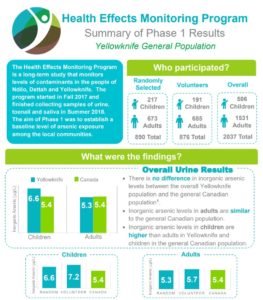
Preliminary Summary Results (2019)
Micro-distribution of arsenic in toenail clippings
This paper outlines work done to investigate arsenic concentrations found in different layers of toenails,…

Cohort profile: Health Effects Monitoring Program
This paper outlines the Health Effects Monitoring Program, including some initial findings of the 2017-2018…
Risk assessment of arsenic exposure